
What difference between Isolation & Quarantine
Isolation: Separating sick people with a contagious disease from people who are not sick.
Quarantine: separates and restricts the movement of people who were exposed to a contagious disease to see if they become sick. These people may have been exposed to a disease and do not know it, or they may have the disease but do not show symptoms.
| Isoaltion | Quarantine | |
|---|---|---|
| Object | infected with the virus, even if not symptomatic | exposed to the virus, but not yet symptomatic |
| Purpose | separates sick people with a contagious disease from people who are not sick | separates and restricts the movement of people who were exposed to a contagious disease to see if they become sick |
Source: What is the difference between isolation and quarantine?
What difference between Latent period & Incubation period
Latent period: The time between exposure to a disease and when symptoms start.
Incubation period: The time between exposure to a disease and when symptoms start.
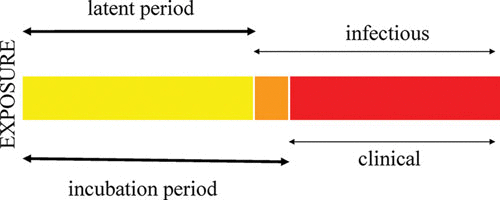
Time line of exposure, infectiousness, and clinical signs. Following exposure to infection, there is a period when the host is infected but not yet infectious—the latent period (yellow)—and a period when the host is infected but not yet showing clinical signs—the incubation period (yellow and orange). In this example, there is a (brief) period when the host is infectious but asymptomatic (orange), as occurs for infections such as influenza or FMD.
What difference between Latent period & Incubation period
Latent period: The time between exposure to a disease and when symptoms start.
Incubation period: The time between exposure to a disease and when symptoms start.
Time line of exposure, infectiousness, and clinical signs. Following exposure to infection, there is a period when the host is infected but not yet infectious—the latent period (yellow)—and a period when the host is infected but not yet showing clinical signs—the incubation period (yellow and orange). In this example, there is a (brief) period when the host is infectious but asymptomatic (orange), as occurs for infections such as influenza or FMD.
No notes.
What difference between Isolation & Quarantine
Isolation: Separating sick people with a contagious disease from people who are not sick.
Quarantine: separates and restricts the movement of people who were exposed to a contagious disease to see if they become sick. These people may have been exposed to a disease and do not know it, or they may have the disease but do not show symptoms.
| Isoaltion | Quarantine | |
|---|---|---|
| Object | infected with the virus, even if not symptomatic | exposed to the virus, but not yet symptomatic |
| Purpose | separates sick people with a contagious disease from people who are not sick | separates and restricts the movement of people who were exposed to a contagious disease to see if they become sick |
Source: What is the difference between isolation and quarantine?
What difference between Latent period & Incubation period
Latent period: The time between exposure to a disease and when symptoms start.
Incubation period: The time between exposure to a disease and when symptoms start.
Time line of exposure, infectiousness, and clinical signs. Following exposure to infection, there is a period when the host is infected but not yet infectious—the latent period (yellow)—and a period when the host is infected but not yet showing clinical signs—the incubation period (yellow and orange). In this example, there is a (brief) period when the host is infectious but asymptomatic (orange), as occurs for infections such as influenza or FMD.
What difference between Serial interval & Generation time
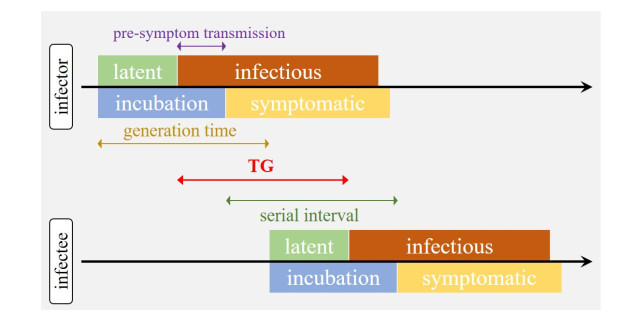
Serial interval: time interval between symptom onset of infector i and symptom onset of infectee j.
Generation time: time interval from infection of i to infection of j.
Source: On the relationship between serial interval, infectiousness profile and generation time
What difference between Endemic & Epidemic & Pandemic
We are familiar with the terms outbreak and epidemic, but what is a pandemic?
Endemic: Consistently present but limited to a particular region. This makes the disease spread and rates predictable. Malaria, for example, is considered endemic in certain countries and regions.
Epidemic: An unexpected increase in the number of disease cases in a specific geographical area. Yellow fever, smallpox, measles, and polio are prime examples of epidemics. An epidemic disease doesn’t necessarily have to be contagious. West Nile fever and the rapid increase in obesity rates are also considered epidemics. Epidemics can refer to a disease or other specific health-related behavior (e.g., smoking) with rates that are clearly above the expected occurrence in a community or region.
Pandemic: Disease’s growth is exponential. This means the growth rate skyrockets, and each day cases grow more than the day prior. In being declared a pandemic, the virus has nothing to do with virology, population immunity, or disease severity. It means a virus covers a wide area, affecting several countries and populations.
Source: Epidemic, Endemic, Pandemic: What are the Differences?